Ways to Make Journalism Pay
The NUJ London Freelance branch (LFB) held a successful all-day gathering on ‘Ways to Make Journalism Pay’ on 10 October.
Making money and keeping it
Following an introduction by Pennie Quinton, LFB co-chair, the first panel of the day focused on making money, chaired by LFB’s Grace Livingstone. Susan Grossman, a mentor and travel writer, shared advice on securing assignments. As a former magazine editor who spent 15 years as a BBC Radio 4 presenter, Grossman stressed the importance of having confidence in your ability and work. She said that the nature of the industry required journalists to network and that the gathering was a perfect opportunity to ask questions, make contacts and secure commissions. "Journalism is all about not knowing much, but knowing someone who does. All you need is to find the right person to help you."
Steven Mathieson similarly encouraged attendees to value their work when pitching and negotiating fees. “It is not embarrassing to ask for too much,” he said. "It shows that you have confidence in your work.” As a former Guardian journalist with over 20 years’ experience as a freelance, Mathieson recommended making your pitch as succinct as possible and encouraged attendees to use NUJ resources, including the Freelance Fees Guide and Rate for the Job. The trainer also highlighted the array of courses - from data journalism to freelance tax - offered by NUJ Training Wales. Later in the session attendees received tax tips from Eric Longley, a tax specialist with years of expertise in the industry.
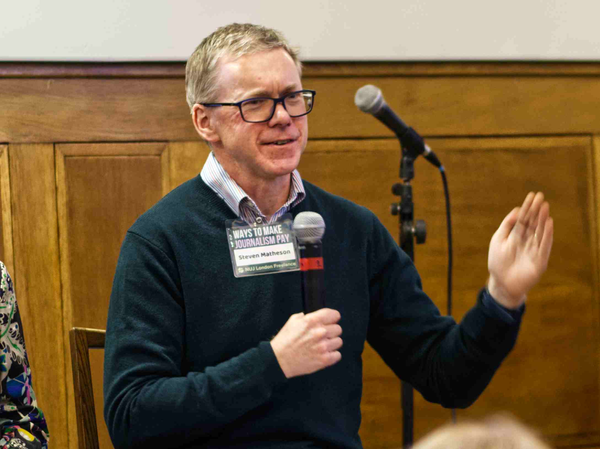
Steven Mathieson.
© Tim Dawson
Eleanor Mills described her transition to freelancing after 23 years at The Sunday Times. Mills said the initial experience was “horrible” - not helped by the headline of her Telegraph article: ‘On the Scrap Heap at 49’. However, she soon found that being self-employed offered an opportunity to become “a one-woman band”. Since going freelance Mills has founded Noon, an online media platform, and created the ‘Queenager’ newsletter to challenge the stereotypical narratives around women between 45 and 70. Mills emphasised that a good life is possible beyond tradition journalism. “This turned out to be one of the best things that ever happened to me.”
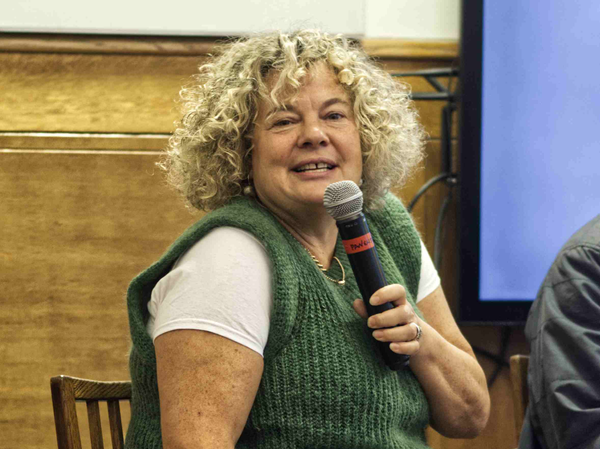
Eleanor Mills.
© Tim Dawson
Book publishing
The second session, chaired by National Executive Council (NEC) member Anna Hervé, focused on book publishing and self-publishing. The panel included Sarah Burton (Society of Authors). James Spackman (Book Pitch Doctor) and April Peake (Bloomsbury commissioning editor).
Hervé introduced the discussion by saying that members in book publishing were experiencing the same issues - from artificial intelligence to poor pay - as those in the rest of the sector.
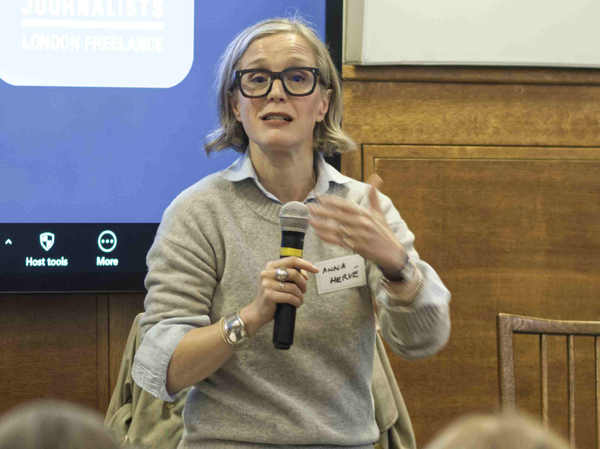
Anna Hervé.
© Tim Dawson
Some have found work through ghost-writing. Burton said ghost-writers can easily be exploited and noted the need for robust contracts. Hervé agreed that publishers can pay ghost-writers poorly and encouraged members to value your expertise and stand up for your interests.
The discussion moved to artificial intelligence and intellectual property. While expressing her rage at the scraping of writers’ work by the likes of Meta and the threat to journalists’ income, Hervé noted that licensing rights can generate passive income. Burton urged writers to retain certain rights, such as licensing for radio-plays or films. “It’s in your interests to licence narrowly whereas your publisher is likely to license broadly - so you’ll need to find a compromise,” she said. "Copyright [in book publishing] is like a cake – each way that your work can be exploited is like a different slice. Working out which rights to sell and which to hold back is vital".
Peake encouraged transparency and open conversations between writers and commissioning editors on licensing, saying that publishers do revert rights in certain circumstances. While AI can be used as an assistive tool, Peake urged extreme caution over the use of generative AI in the production of work.
Spackman spoke about the role of literary agents, who typically help writers sell their work for a 15% fee in the UK and 20% overseas. Some agents see their role as coaching authors and nurturing talent. Others are less involved in the editorial process but focus on securing a good deal for their clients. As a former author, Spackman sees his role as holding the publisher accountable for fulfilling their responsibilities and carefully scrutinising contracts.
Burton and Hervé similarly urged attendees to be professional, do your research and follow submission guidelines when pitching to agents and publishers. “We want to commission people who are good to work with and know their stuff.” Writers can find a register of bona fide agents from the Association of Authors’ Agents. Burton advised writers who are concerned about the theft of their work to explicitly state that you are pitching work in confidence. Authors looking for agents should study the acknowledgments in books in the subject area they are writing about.
Throughout the day NUJ trainers, reps and officials ran a series of one-to-one specialist surgeries on tax, pitching, digital journalism, and more.
The first session of the afternoon focused on investigative reporting, chaired by freelance producer-director Giovanni Ulleri.
Investigative journalism
Latin America specialist Grace Livingstone shared lessons from her investigation into water scarcity in Uruguay. Combining on-the-ground reporting and investigative analysis, Livingstone uncovered that Danone had been extracting water in perennially water-stressed regions, bottling it, and then selling it back to people who didn’t have safe water at home. Livingstone realised that this was happening all over the world with multinational corporations such as Coca Cola, Nestlé and PepsiCo following the same playbook.
Livingstone emphasised the importance of drawing on the knowledge and experiences of grassroots activists. Once you start investigating a subject, people will often proactively contact you with new information and angles. She noted that the great investigative Paul Foot said that all his stories came from an inside source.
“The main difficulty,” said Livingstone, “is that most investigations take a lot of time - so how are you going to get paid?” The LFB committee member recommended asking for a research fee, paid expenses, and presenting stories in various formats, for example pitching a written feature alongside a radio documentary.
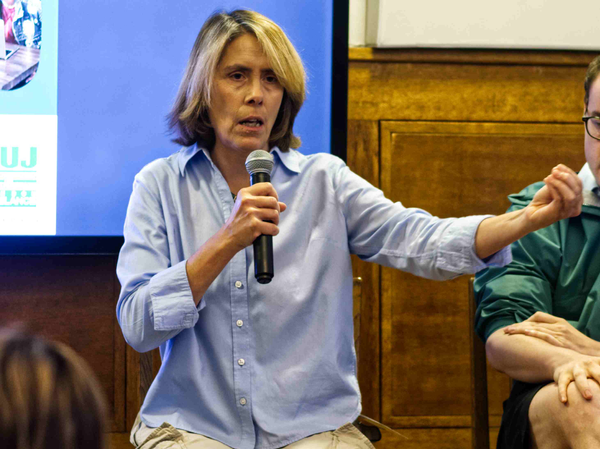
Grace Livingstone.
© Tim Dawson
John McEvoy outlined the work of the independent publication Declassified UK. In an environment where there are fewer resources and considerable reputation associated with investigative journalism, it can be tempting to assume that there is a greater appetite for a 30-second social media video rather than a 4,000-word exposé.
Yet Declassified’s work has generated significant interest and impact, said McEvoy. Focusing on the publication’s investigations into the Israeli Defence Forces (IDF), he recalled how a Freedom of Information (FOI) request found that 15 IDF soldiers had recently undertaken training in the UK. The journalists then used facial recognition software to identify the soldiers and put questions to the UK government. The government subsequently banned all UK training courses for IDF soldiers.
McEvoy highlighted the importance of cross-border collaboration. Declassified subsequently worked with journalists in Israel to put FOI requests to the Israeli government. This requests revealed that over 2,000 British nationals had fought for the fighting for the IDF since 7 October 2023, and that there was sufficient evidence to warrant an investigation into claims they had committed war crimes in Gaza.
Safety and teamwork are vital to successful investigations. Media organisations have a duty of care to their journalists - both during the investigation and after publication. There are also individual safety precautions to consider. For example, investigative journalists - particularly those travelling abroad - should seriously consider limiting their social media use. You need to know what you’re getting yourself into and have backup. “No story is worth risking your life for”, said Ulleri.
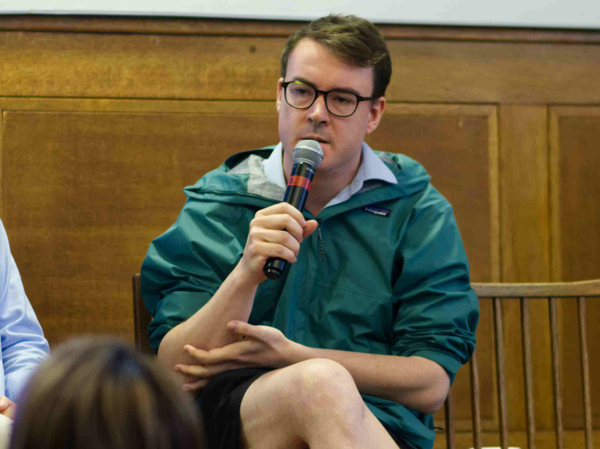
John McEvoy.
© Tim Dawson
Broadcasting assignments
The final session of the day on broadcasting assignments also focused on assessing and mitigating risk. Sky News presenter Alex Crawford, speaking via video link, emphasised her team’s huge reliance on working with local journalists when reporting from Yemen. “You learn to rely on the people who know the area much better than people like us to do when we fly in,” she said.
Working and developing trust with local journalists has been vital to navigate security risks when travelling between government and Houthi-controlled areas. Crawford stressed that journalists should always be mindful about what you are shown and given access to, describing the sense of responsibility she feels to get the story right.
Again, employers have a duty of care to journalists reporting from conflict zones. This includes conducting risk assessments and mental health provision for those exposed to trauma. “But sometimes there is nothing you can do to legislate against unpredictable danger,” she said. “You just have to cope with it as best you can when things do go wrong.”
Commenting on the number of high-profile female foreign correspondents, Crawford said that women are used to dealing with hostile environments “because when they start off, the newsrooms are hostile”. Crawford underlined the shared sense of collaboration and community with fellow female correspondents and local journalists: “I respect them enormously. We’re very supportive of each other.”
Chairing the session, Quinton asked Crawford about the mental and emotional toll of reporting from conflict zones. Covering war is not a normal life, noted Crawford, who said it was “cheering" to hear others acknowledge the impact of years of exposure to trauma and injustice. Crawford admitted that she has “had her moments - particularly over the coverage of Gaza. It didn’t matter how many times we showed ambulance workers being targeted and killed, or women were being blindfolded and disappeared by Israeli forces. It didn’t seem to matter what evidence as journalists we could produce. The people making the decisions who could make a difference didn’t. That was as desolate place to be and I know it affected a lot of reporters.”
Paying tribute to the “incredible” work of her colleagues and Palestinian journalists who experience constant smears, Crawford said:
“But we have a duty as journalists to carry on. And it’s much, much harder as freelances - I don’t know how you do it - but we are still an absolutely fundamental, necessary industry. And journalists generally want to do an honourable job; I’m still very proud to be part of this profession. There is some incredibly good journalism that has really shone through - that is incredibly motivating and should inspire us all.”
Quinton thanked her colleagues at the London Freelance branch for their hard work in organising an excellent event.